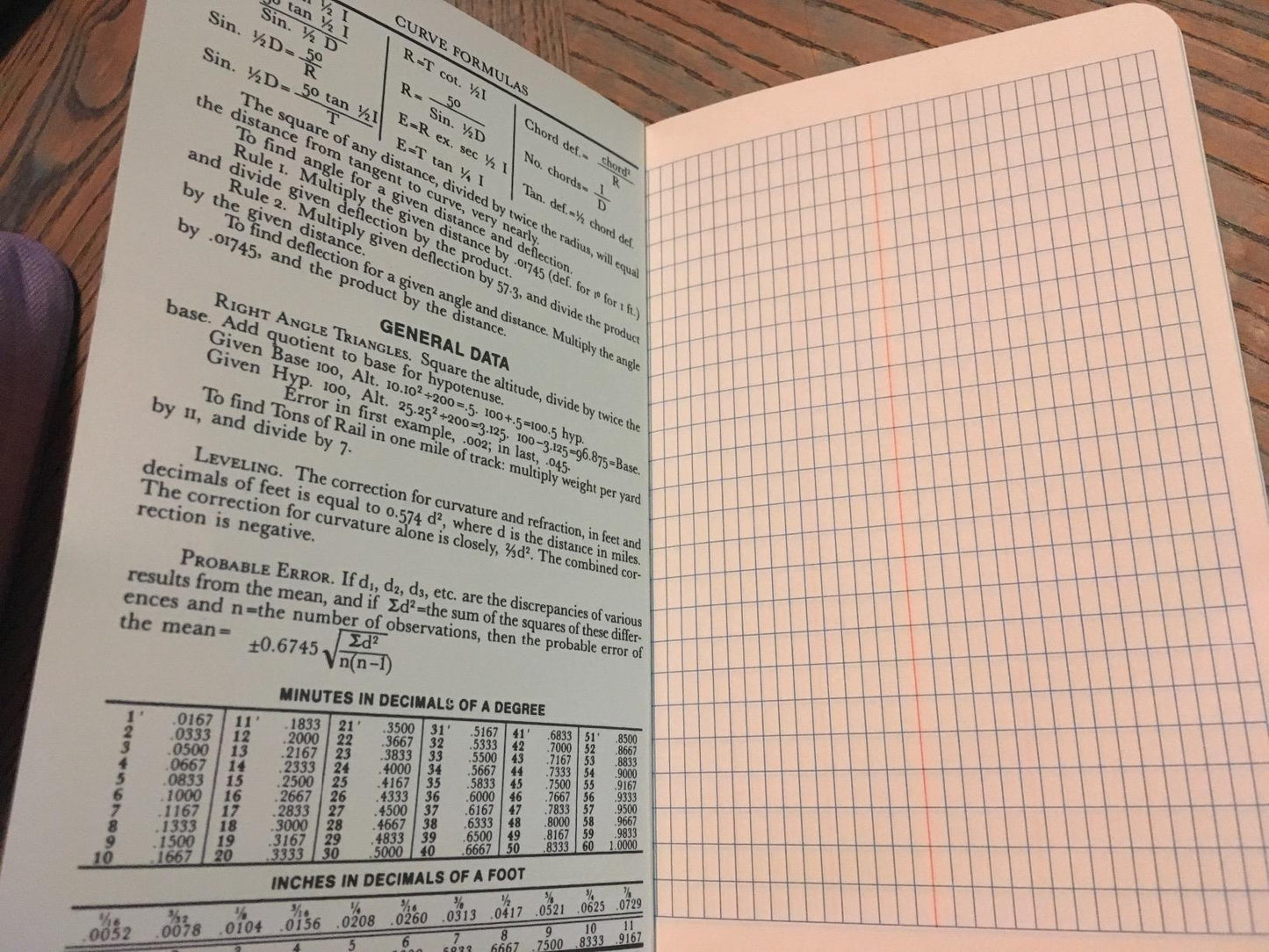
Elan Publishing Company Surveying Field Book 4 5/8 x 7 1/4 - Uncluttered Pocket Book for Intentional Field Note Taking
Elan Publishing Company Surveying Field Book 4 5/8 x 7 1/4 - Uncluttered Pocket Book for Intentional Field Note Taking
Couldn't load pickup availability
Why you'll love it
- Water-resistant 50% cotton paper keeps notes legible in rain, mud, or humid conditions
- High-visibility orange cover is easy to spot among gear, leaves, or snow on a busy site
- Pre-ruled dual-format pages (6 columns left, 8x4 grid right) eliminate time-consuming setup
- Sewn binding holds up under rugged handling where glued notebooks fall apart
- Archival-quality paper preserves legally important field records for decades
Perfect for
- Recording traverse, boundary, and topographic measurements in the field
- Logging forestry stand data and environmental observations on-site
- Documenting construction layout, elevations, and inspection notes
- Plotting grid-based data sketches alongside tabulated measurements
- Archiving permanent field records for legal and project documentation
About this item
The Elan Publishing Company sewn field book has sturdy cover with 64 pages. Inside quality white Ledger paper is special formulated for maximum Archival service with material that is 50 percent cotton and water resistant.
- Package Dimensions : 8.19 x 4.8 x 0.51 inches; 1.59 ounces
Frequently Asked Questions
Is the design of this field book clean and uncluttered?
Yes. The pages use a simple two-zone layout with light-blue columns on the left and a faint grid on the right, providing structure without visual noise so the focus stays on your data.
Does the orange cover clash with a minimalist kit or workspace?
The bright orange is actually chosen for utility, but the cover is a single flat color with no logos or graphics competing for attention, so it reads as a single bold accent rather than a busy design element.
Is the format simple enough that I can use it my own way?
Yes. The dual ruling is intentionally minimal: just columns and grid, with no extra headers, branding, or pre-printed labels, so you can adapt the structure to your own recording style.
Are there any unnecessary extras like stickers, samples, or extra pages included?
No. The book is intentionally pared down to 64 pages of pre-ruled paper bound in a stiff cover, with no samples, advertisements, or extra inserts to get in the way.
Will the cover design hold up without looking worn quickly?
The orange cover is a single-color, matte-finish material that resists scuffs and weathering, so it develops a natural patina with use rather than looking damaged or dated.
Is this a good notebook if I prefer a less-is-more approach to gear?
Yes. It combines the ruling, the cover, and the binding into one straightforward object, so you don't need separate sketch pads, column pads, or protective cases to get a complete field documentation tool.
Does the size feel intentionally compact rather than bulky?
At 4 5/8 x 7 1/4 inches, it is sized to fit a pocket without wasted space, which fits a minimalist carry philosophy of taking only what you actually need into the field.
Can I use one book for multiple purposes without it feeling overstuffed?
Yes. The combination of columns and grid on the same page means you don't need separate notebooks for numbers, sketches, and notes, allowing one slim book to serve your entire field workflow.
Is the page layout restrained enough to work in black-and-white photocopies?
Yes. The light-blue columns with red vertical lines and the gray-toned grid reproduce cleanly in photocopies and scans, so you can archive or share pages without losing legibility.
Does the sewn binding add visual bulk to the book?
No, the sewing is integrated into the spine, so the book has a clean, flat profile from the front cover to the back cover with no exposed hardware or thick plastic coil.
Will the simple format work for both sketches and tabular data?
Yes. The left columns are for structured data and the right grid is for freeform sketching, and you can ignore whichever side you don't need on a given page, which keeps the format flexible without adding complexity.
Is the cover material simple and functional rather than decorative?
Yes, the orange cover is a single utilitarian material chosen for visibility and stiffness, with no patterns, embossing, or decoration beyond the product information printed on the front.
Does this book encourage intentional note-taking rather than scribbles?
Many users find that the pre-ruled structure naturally encourages them to record data in its proper place on the page, which leads to cleaner, more intentional field notes over time.
Can I keep my field kit simple by relying on this one book?
Yes. With column and grid ruling, a stiff cover, and sewn binding all in one pocket-sized book, you can leave the clipboard, the loose-leaf paper, and the extra notebook at home.
Is the design timeless enough that it won't look dated in a few years?
The simple dual-ruling layout and single-color cover have been a standard field book design for decades, so it remains visually consistent whether you bought it last year or ten years ago.
I'm not sure a pre-ruled book fits a minimalist mindset, won't it constrain how I take notes?
The ruling is light enough to ignore if you want to write freely, and structured enough to use if you want guidance, so it provides optional structure rather than imposing a strict template on your notes.
How do I set up the book for recording a traverse?
Open to a fresh page, record the project name, date, crew, and instrument information at the top of the left columns, then begin logging point number, backsight, foresight, horizontal distance, and vertical readings in order. Use the right-hand grid to sketch the traverse layout alongside each setup.
How should I store the book between field sessions?
Keep it in a dry place like a desk drawer or vehicle cab, ideally flat rather than folded or compressed, and avoid prolonged direct sunlight to preserve the cover color. For long-term archival storage, store it in an acid-free folder or box at normal room humidity.
What is the best way to scan or copy pages from this book?
Photocopy or scan pages while the book lies flat, pressing the spine gently to avoid shadows near the binding. Because the ruling is light, increasing the scan contrast slightly can help column lines and grid reproduce more clearly for digital archives.
Does this book fit standard surveyor vest pockets?
Yes, the 4 5/8 x 7 1/4 inch dimensions are designed to fit the chest and cargo pockets found on standard surveyor and forester vests, as well as most jacket and cargo pants pockets.
Is this book compatible with archival scanning and microfilm standards?
Yes, the 50% cotton ledger paper meets archival quality standards and is suitable for scanning, microfilming, and long-term digital archiving of legal and project records.
What comes in the package when I order this book?
You receive one Elan Publishing Company field surveying book with 64 pages (32 sheets) of pre-ruled 50% cotton ledger paper, bound in a high-visibility orange stiff cover. No additional accessories, pens, or rulers are included.
Is the paper safe to handle for people with sensitive skin?
Yes, the 50% cotton ledger paper is a standard archival writing surface with no unusual chemical treatments that cause skin irritation during normal use.
Will the book remain usable if it gets bent or crumpled in transit?
The sewn binding and stiff cover are designed to absorb rough handling, so minor bending typically flattens back out. Significant crumpling may crease pages but usually does not affect legibility or the binding's function.
What is the difference between a field book, a survey notebook, and a standard notebook?
A field book or survey notebook uses archival, water-resistant cotton paper with pre-printed ruling designed for measurements and sketches, and a sewn binding built for rugged use, while a standard notebook typically uses wood-pulp paper, glue binding, and blank or lightly ruled pages suited to office use rather than outdoor documentation.